Continuing Noor’s Ramadan tradition of  social justice iftars, we offer this special program in honour of Earth Week:

“All Our Relations” and “Communities Like You”:
An Anishinaabe-Muslim Conversation on Conceptualizing Human and Other-Than-Human Relationships

Please join us for this conversation between Anishinaabe scholar Eva Jewell and Islamic scholar Sarra Tlili, on how we might (re)conceptualize human relations with other-than-humans towards love, justice, and care. As always, everyone, regardless of faith or observance, is welcome.

Dr. Eva Jewell is Deshkan Ziibiing Anishinaabekwe (Chippewas of the Thames First Nation) with paternal lineage from Oneida Nation of the Thames. Her scholarship supports community-led inquiry on topics of reclaiming Anishinaabe governance, with interest on the role of women/femmes. Dr. Jewell’s recent research areas include urban Indigenous perspectives on gender, work, and care; and accountability in reconciliation. She is Research Director at the Yellowhead Institute and an Assistant Professor of Sociology at X University.

Dr. Sarra Tlili is a scholar of Arab and Islamic studies, and an Associate Professor of Arabic Language and Literature at the University of Florida. Her primary research interests are stylistics of the Qur’an, animals in Islam and Arabic literature.  Dr. Tlili is the author of Animals in the Qur’an (Cambridge University Press), an examination of the status and nature of animals as they are portrayed in the Qur’an and in adjacent exegetical works, in which animals are viewed as spiritual, moral, intelligent and accountable beings.

Following the breaking of the fast at 8:05 PM EST, maghrib prayers (for those who wish to participate) will be led by Sheikh Dr. Khaled Abou El Fadl (Usuli Institute; Professor of Law, UCLA)

Sponsors:
Yellowhead Institute
Usuli Institute 
ClimateFast 
Islamic Social Services Association (ISSA) 
Let the Quran Speak
North American Cultural Diplomacy Initiative (NACDI)


Date: Monday April 18, 2022
Time: 7 pm EST
The program will end just before 8:05 pm EST, at maghrib (sunset) with the adhan (call to prayer, signaling also the end of the day’s fast)

The book Dr Jewell was referring to is Yamoria the Lawmaker: Stories of the Dene by George Blondin.

Dr. Sarra Tlili’s book is called “Animals in the Qur’an”

It’s Asr Time on the 17th of Ramadan 2022.

Today is also The Anniversary of The Battle of Badr.

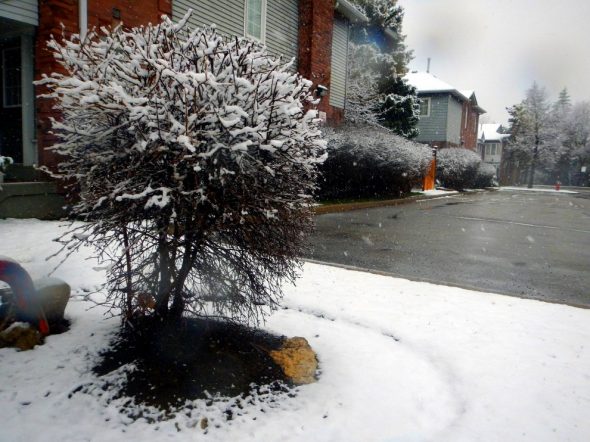
And also today… it’s snowing !

I stepped out for a few moments and recorded this video…


This is only the second time I have seen snow during Ramadan since 30 Masjids in 30 Days began in Ramadan 2011.

The first time I blogged about it snowing was Day 9 of Ramadan 2021.

SubhanAllah.


“Using public art as a platform,

we hope to improve the visibility of Muslim identities in urban spaces.

Public art adds meaning to our cities and character to our neighbourhoods.

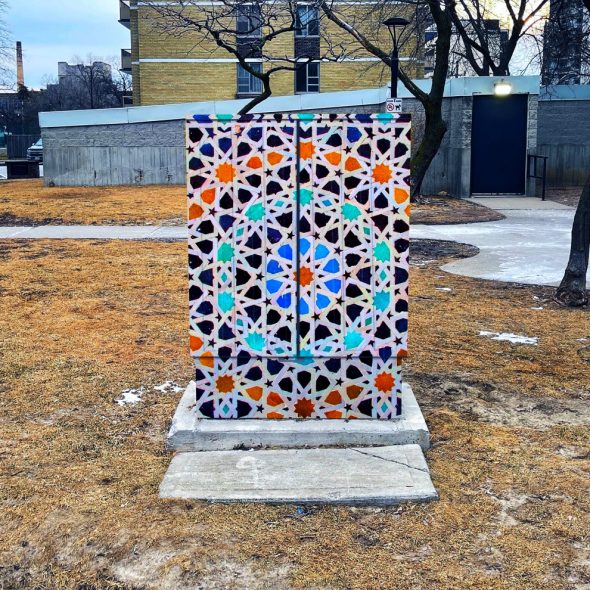
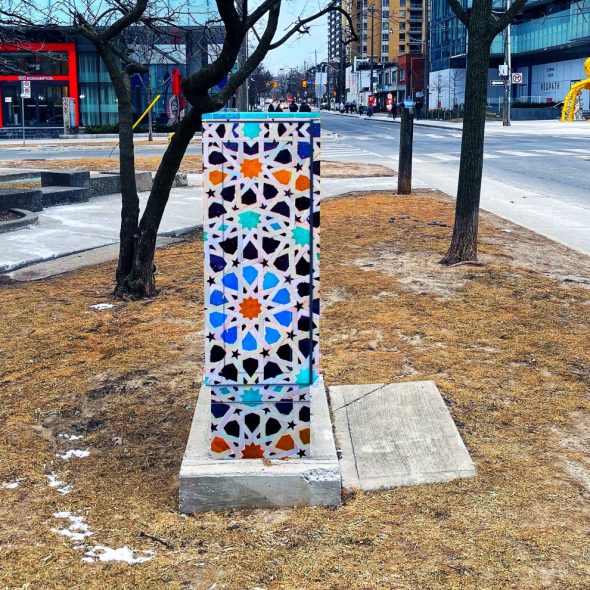
A project we’re working on transforms traffic signal boxes.

We applied to #OutsideTheBox2022

Our project “Geometric City” is inspired by Zellige tiles,

a type of mosaic tilework in which each tile piece is individually hand-chiselled into a colourful mosaic.

These tiles can be found on the columns,

doors and walls of Mosque,

Madrasas and other built forms.

learn more about the project & at Zellige tiles.

— By Muslims in Public Space, Toronto, Ontario

Tonight’s Resilient Hour with Dr. Jasser Auda was a Dream come true.

Literally.

Watch, listen, and learn about Ru’ya as-Sadiqa, true dreams.

This is Al Wahy.


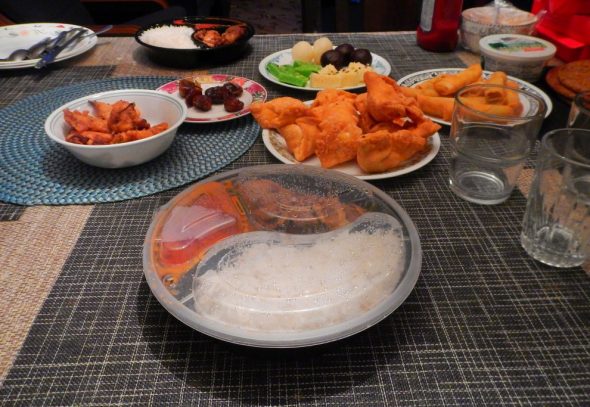
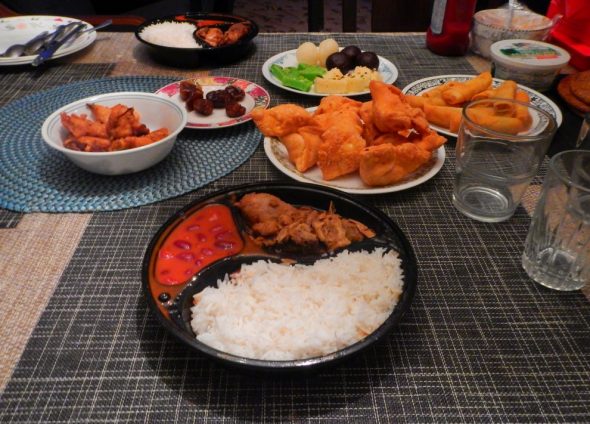
Tonight’s Iftar was a belly come full.

Literally.

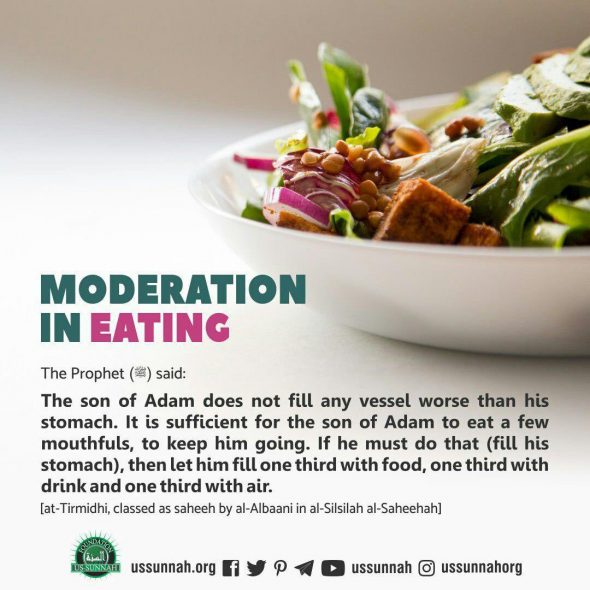
Okay, one third full, one third liquid, and one third air.

This is The Way.

Alhumdulillah.

Weren’t we just here?

At Sayeda Khadija Centre for Jumah ?

Yes, yes we were.

Here we are again . . .


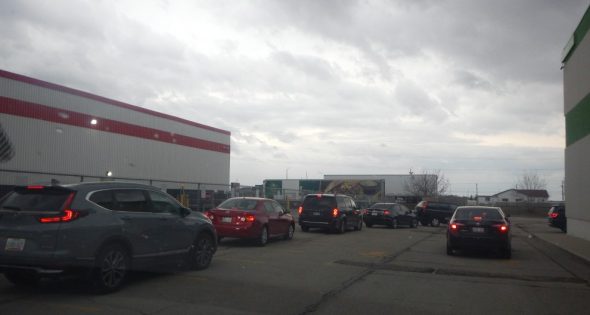
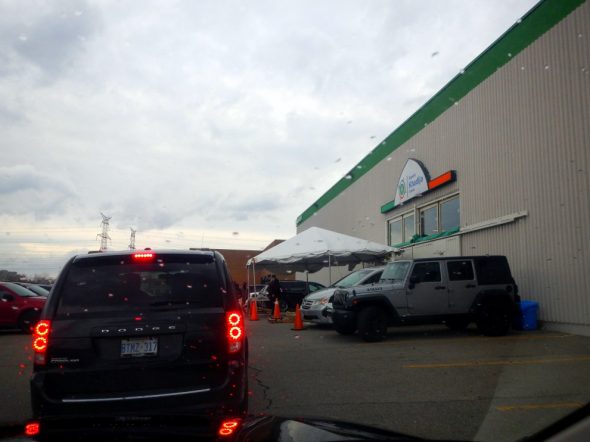
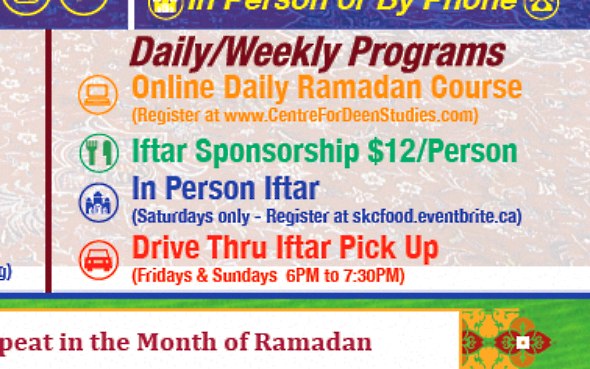
. . . Picking up Iftar Dinners at SKC‘s Friday Evening Drive-Thru.

Many Masjids offer 20 Rakats of Taraweeh, others stop at 8 Rakats.

At Masjids where 20 Rakats are observed, many worshippers exit after 8 Rakats.

So how many Rakats (units) of Prayer is Taraweeh… really?

The Islamic Institute of Toronto historically has organized Taraweeh with 20 Rakats followed by 3 Rakats of Witr.

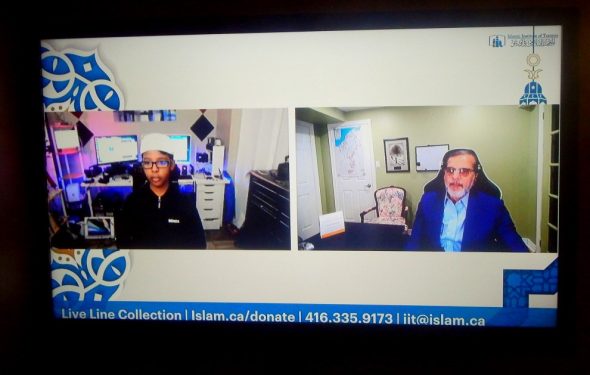
At the start of Ramadan 2022, our third Ramadan during this Global Corona Virus Pandemic, Resident Scholar Shaikh Ahmad Kutty explained IIT’s reasoning in hosting 8 Rakats of Taraweeh this year…

The Decision to Pray Eight Rak`ahs of Taraweeh at IIT is Temporary

Shaikh Ahmad Kutty

“Taraweeh is an important Sunnah of the Prophet (peace upon him).

The Prophet (peace be upon him) established a precedent by performing it three nights in congregation.

He discontinued it, however, out of concern that Allah could make it obligatory because of the zeal of the congregants.

Umar, the pious caliph, understood why the Prophet had chosen to discontinue taraweeh.

Therefore, when there was no concern over Allah making it mandatory, he organized taraweeh prayer led by Ubayy b. Kab, the famous scholar of the Qur’an.

Ubayy chose to pray twenty rak’as.

The precedent thus set was then followed by most Muslims in the centuries that followed.

According to well-attested reports from Aisha, the beloved wife of the Prophet, the Prophet never prayed more than thirteen rak’as.

But the Prophet never said that one could only pray thirteen.

When asked about optional prayers one may pray after isha; his answer was:

“One should pray it in two’s and two’s.

However, if there is a fear of dawn approaching, one should close it with at least one Rak’a of Witr.“

As for the contention about the precise number of Rak’as,

Ibn Taymiyya has analyzed the issue and summed it up as follows.

“We may pray twenty as is the view of Ahmad, Shafi;
or thirty-three as is the opinion of Imam Malik;
or eleven or thirteen (including Witr as the Prophet did it).

It is all good.

The number can vary according to the conditions of the worshippers.

It is acceptable if they can stand long hours reading with ten rak’ahs followed by three rak’ahs of Witr.

On the other hand, they can choose to pray twenty rak’as if they do so, considering the comfort level of the congregation.

That has been the precedent followed by most Muslims through the centuries.

It is the middle position between the eleven or thirteen and the thirty or forty, as various people hold.

However, it is wrong for anyone to state that the Prophet fixed the number of rak’ahs so that we can neither add nor subtract from it.”

Since its inception, we at the Islamic Institute have been praying twenty.

Some congregants choose to leave after eight, others at ten or twelve.

The same practice occurs in the Haramayn.

The recent announcement that we will start with eight was primarily due to administrative considerations and to prevent the spread of COVID infections by a sudden opening of the services since we are still not out of the woods yet.

It is only a temporary policy, and we hope to return to our previous practice of praying twenty as soon as we have some reassurances regarding health & safety.

I urge everyone to pray to Allah to heal our community and help us to get back to our routine and precedents as soon as possible.”

Shaikh Ahmad Kutty’s words are important and useful for anyone wanting to understand the history and rationale of observing the optional Taraweeh Prayer.

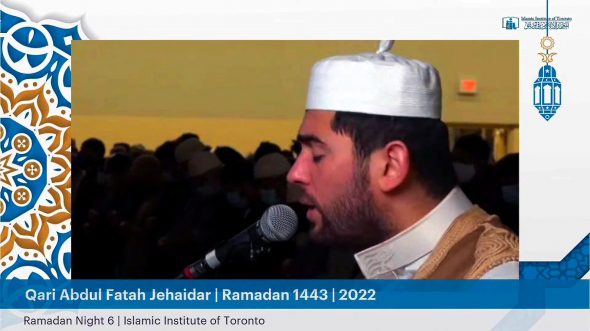
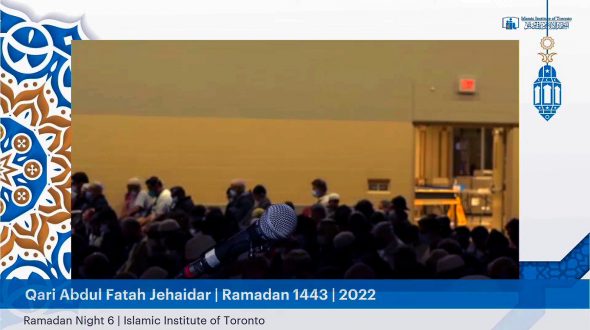
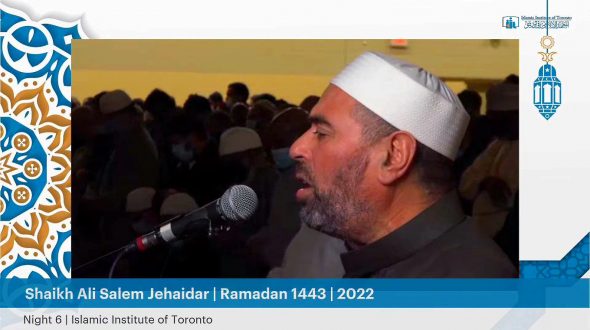
On Night 6 of Ramadan 2022,

Qari Abdulfatah Jahedar & Qari Ali Salem Jahedar led IIT‘s Congregation in 8 Rakats of Taraweeh.

If you are outside of Ontario and because of online geo-restrictions cannot listen to the Special Daily Ramadan Radio Program from Reflections on Islam,

Resilient Hour from the Islamic Institute of Toronto is a good go-to, at least 2/7ths of the time.

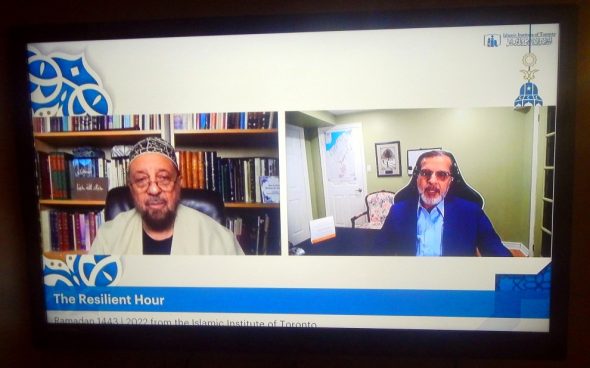
Tonight is the second of IIT’s twice weekly Resilient Hour shows being livestreamed on Mondays and Wednesdays throughout the Holy Month of Ramadan 2022/1443.

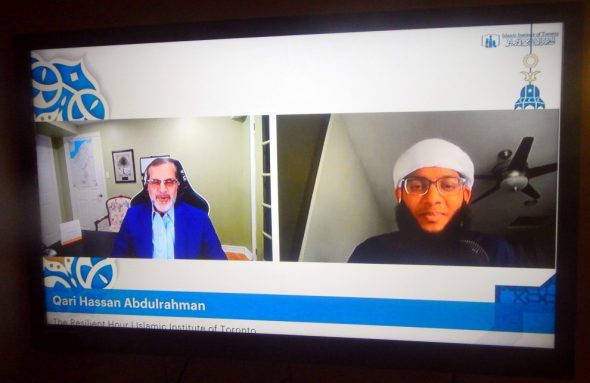
Qari Hassan Abdulrahman opened the Resilient Hour reciting verses of the Qur’an.

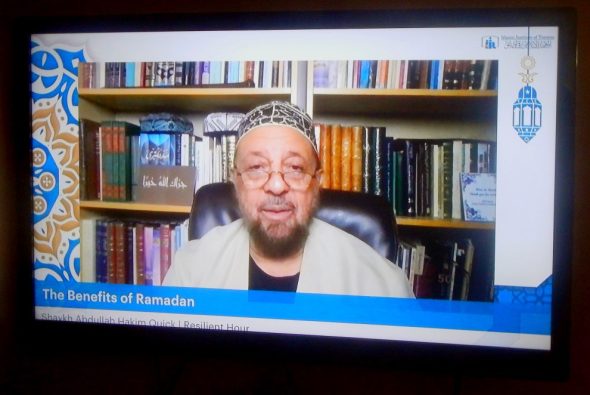
Speaking tonight was Shaikh Abdullah Hakim Quick about The Benefits of Ramadan.

We listened & watched the Resilient Hour while we readied ourselves for Adhan Al Maghrib and the time to break our fast.

Adhan Al Maghrib tonight was called by one of the younger members of the IIT Congregration, Brother Omar Hassan.

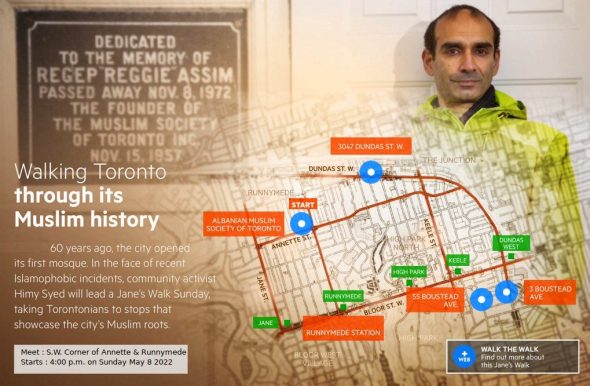
JANE’S WALK DETAILS:

Following an Islamophobia incident in North York in late 2015, HïMY SYeD led “The History of Muslims in Toronto – A Special December Jane’s Walk” a few days before Christmas.

It was well attended; much was learned, much was understood.

That very long walk was intended as a never-to-be-repeated event.

Yet Islamophobia persists… Quebec City Mosque Attack, and then Etobicoke, and then London.

This Jane’s Walk explains how 3rd, 4th, & 5th Generation Muslim Torontonians helped build our city.

This Jane’s Walk will visit four locations in The Junction and High Park neighbourhoods to reveal that history.

Walk stop locations:

  • The little known history of The Albanian Muslim Society of Toronto – The pivotal role of its founder, Reggie Assim
  • The Dundas Street Mosque – The City’s First masjid
  • Toronto’s FIRST Halal Butcher Shop – Roncesvalles Village
  • Jami Mosque – Toronto’s Second Islamic Centre and its national significance

TIME: Sunday May 8 2022 – 4:00 p.m.

MEETING POINT: Annette Street at Runnymede Avenue, Sidewalk on South West Corner of intersection.

WALK LEADER: Holding Orange “Walk With Us” Jane’s Walk sign; wearing a Green Square🟩

NEAREST PUBLIC TRANSIT: Runnymede Bus stop at Annette Street

WALK END LOCATION: Jami Mosque, 56 Boustead Avenue

Please help get the word and as important…

…Join This Special Jane’s Walk!

See YOU on Sunday May 8 2022, and Thank You!

​As part of the Green Square Campaign🟩, Green Squares (with safety pins) will be available for all who wish to wear one during this Jane’s Walk.

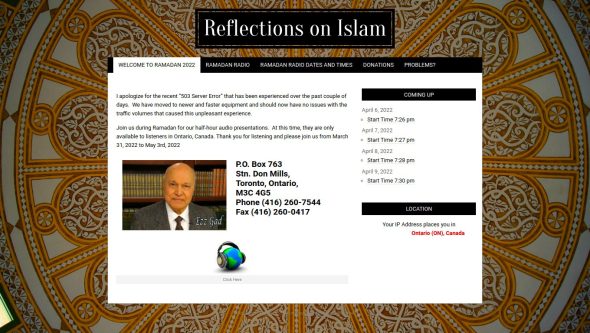
Reflections on Islam

Special Ramadan 2022 Daily Radio Program

Hosted by Ezzedin Gad

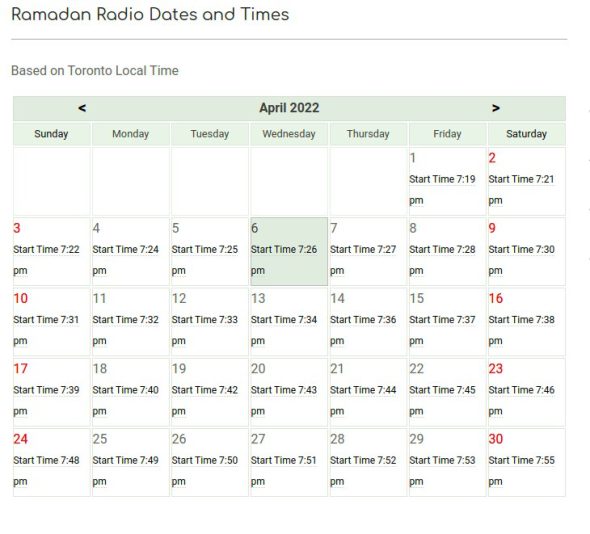
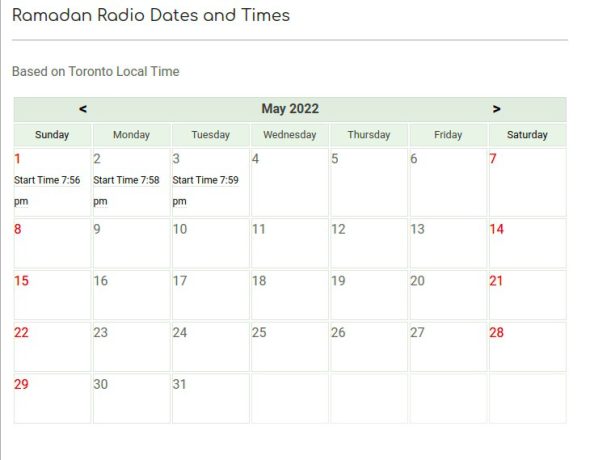
Livestreams began on Friday April 1 2022 and continues every evening until Tuesday May 3 2022.

Starts 30 minutes before Maghrib/Sunset according to Toronto Local Time.

Today’s program began at 7:25 p.m.

Ramadan in Toronto without Reflections on Islam, well, Alhumdulillah we don’t have to think about that this year.

This Radio program really is an unmistakable part of Toronto’s Muslim History and Toronto’s Muslim Heritage.

This program must have provided an important connection during these past two Pandemic Ramadan Lockdowns when masjids were closed then opened then closed and closed again.

For some not quite ready to break fast inside a masjid this third Ramadan of the Pandemic, this daily livestream is still here for you to hear.

So today, Day 4 of Ramadan 2022, we livestreamed the Ramadan Program while we prepared Iftar, and waited until Sunset according to Toronto local time.

We didn’t have to watch the clock.

We only had to wait and listen for Adhan Al Maghrib on today’s Ramadan Radio Program Livestream…


Livestream : https://reflectionsonislam.tv/ramadan_radio/

Only listeners in Ontario can livestream online at this time.

You can support Reflections on Islam by donating here.

During the Lockdowns during the previous Pandemic Ramadan, the IIT, Islamic Institute of Toronto, created a nightly livestream program.

They named it The “Resilient Hour”.

“Resilient” is a word meaning adapting to change.

“Hour” in Islam often refers to that Final Hour, The Day of Judgement, which is ever-approaching.

And adapting to changes during the Pandemic is what we all had to do.

IIT’s nightly livestream became a lifeline of sorts, a connection for a congregration who because of The Province of Ontario COVID-19 Stay at Home orders, could not congregate in person during Ramadan.

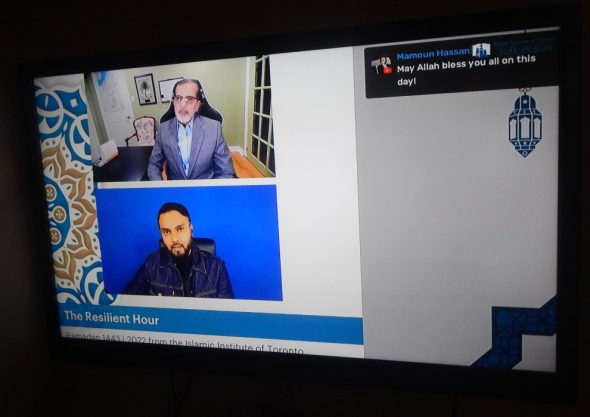
Shaikh Musleh Khan who is speaking tonight, was also speaking on Day 1 of Ramadan 2021, when we watched the first Resilient Hour livestream.

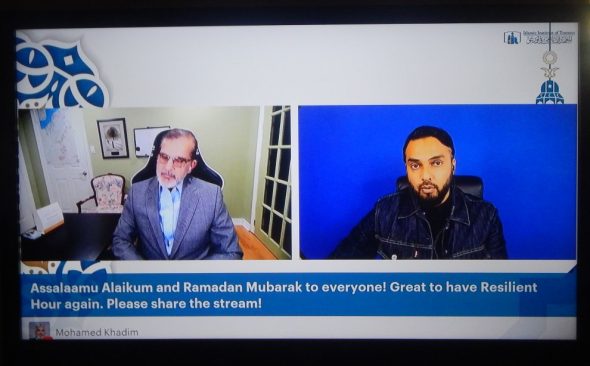
“​Assalaamu Alaikum and Ramadan Mubarak to everyone!

Great to have Resilient Hour again.

Please share the stream!”

– Mohamed Khadim

Last Ramadan 2021, Resilient Hour was livestreamed every night.

Resilient Hour this Ramadan 2022 will be livestreamed on Mondays and Wednesdays only :

  • Monday April 4 2022
  • Wednesday April 6 2022
  • Monday April 11 2022
  • Wednesday April 13 2022
  • Monday April 18 2022
  • Wednesday April 20 2022
  • Monday April 25 2022
  • Wednesday April 27 2022

Resilient Hour begins livestreaming around one hour before Maghrib/Sunset according to Toronto local time / Eastern Daylight Time.

youtube.com/c/IslamicInstituteofToronto/live

IIT’s decision to keep livestreaming Resilient Hour this Ramadan, even if it is only twice on Mondays and Wednesdays rather than every night, shares something with Sayeda Khadija Centre.

Sayeda Khadija Centre in Mississauga is still doing Drive-Thru Iftar Pick Ups, a good idea they appear to be keeping from the full lockdown Ramadan days.

Even though Masjids in Ontario can operate without capacity limits, for now, we ARE in a 6th Wave of the Corona Virus Pandemic.

Ramadan 2022 could technically look like Ramadan 2019.

…Except we’re all wearing masks.

Similar to how Remote Working from Home became normal during the Pandemic lockdowns and is something Society is keeping.

Perhaps in addition to Drive-Thru Iftar Pick Ups, IIT’s Resilient Hour Livestreams also remain part of the Regular Ramadan Experience in Toronto.

The other contribution to Ramadan Culture in Toronto that IIT can continue, and SHOULD continue are their Drive-Thru Cup Cake Pick Ups !

Those were the best!

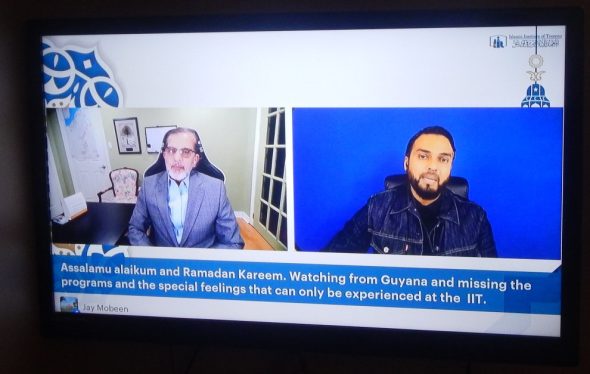
“Assalamu alaikum and Ramadan Kareem.

Watching from Guyana and missing the programs and the special feelings that can only be experienced at the IIT.”

– Jay Mobeen

Jay Mobeen was watching the Resilient Hour Livestream from Guyana ?

Might have to add another “I” to the “I I T”…

The “International” Islamic Institute of Toronto !

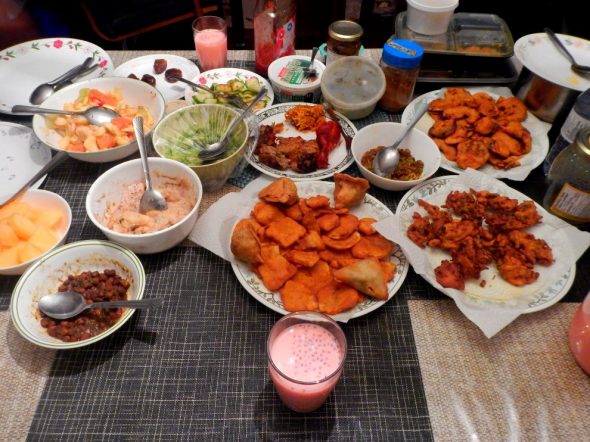
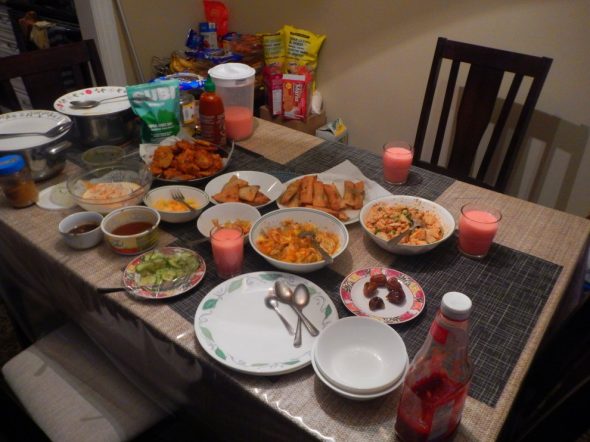
Tonight’s Iftar spread over our dining table while listening/watching to Adhan Al Maghrib on Resilient Hour cast onto our TV.


Toronto’s Metropolitan Area is vast.

While IIT is physically located in the north-east pocket of the city’s boundaries, being closer to Pearson Airport might mean you break your fast a minute after they begin livecasting Adhan Al Maghrib in Scarborough.

Scarborough was a city that got gobbled up into the amalgamated MegaCity of Toronto on January 1 1998.

IIT, where the sidewalk ends, or used to end, is in Scarborough.

IIT sounds better than IIS.

So… Maybe something good came out of Amalgamation after all ?

Aside : I was casting the livestream to our Television from my Raspberry Pi 400 via a fire stick. SubhanAllah, no glitches.

““How should I break my fast?”

This is my most common patient question this week.

As 2 billion Muslims start #fasting for Ramadan I’ll answer here from my perspective as a doctor & cardiometabolic researcher.

Hopefully you’ll find takeaways to enjoy a #RamadanMubarak

A thread…

First and foremost a disclaimer that I’ll be answering from a scientific standpoint, not as a religious expert.

You may see, though, that much of the medical reasons here coincide perfectly with the sunna or tradition of Prophet Muhammad PBUH (not surprisingly).

Now to answer the question.

The best thing to break your fast with are dates.

Dates are full of key ingredients that are very helpful after a long fast.

First, they’re high in fructose & glucose which helps rapidly restore low blood sugar.
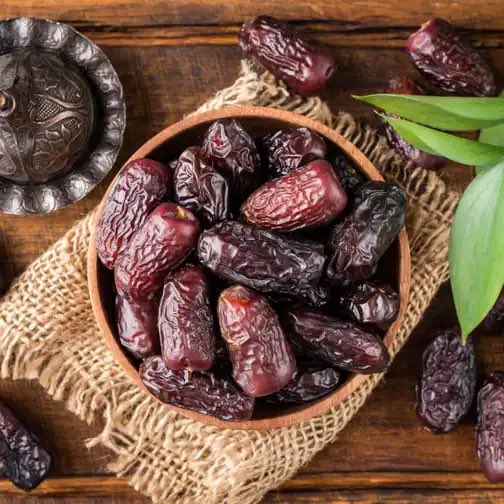
There are several other essential vitamins & minerals such as potassium, which is particularly important here…

When fasting, potassium excretion increases early on.

In fact, when we clinically prescribe intermittent fasting or protein-sparing modified fasts for weight loss we closely monitor electrolytes, and sometimes have to give potassium chloride supplements.

Being able to naturally replenish potassium along with fruit sugar is very helpful.

Dates are also chock full of other vitamins & minerals including magnesium, B6, fiber (which helps you feel full), and antioxidants.

The high caloric density of these small fruits is also convenient- they give nutritional value without occupying much room in your shrunken stomach.

So from a scientific standpoint, it makes perfect sense why this was the Prophet PBUH’s preferred food to break fasts with.

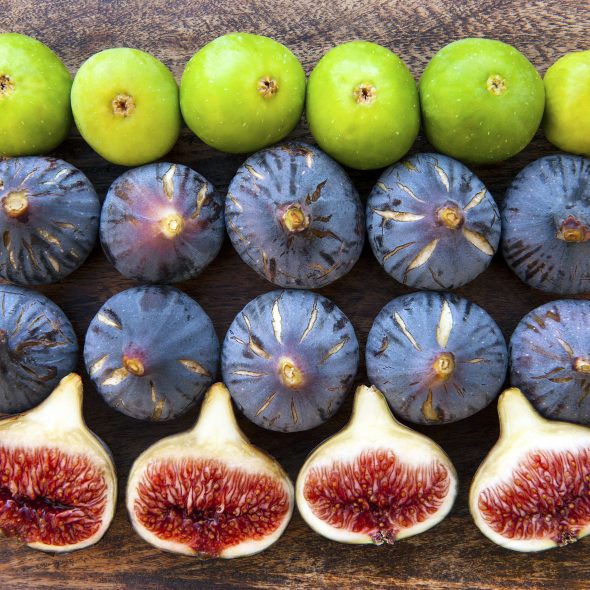
If you don’t have dates, consider other fruits with similar benefits such as apples, figs, or pears.
As for what to drink, the best is WATER.

Not tamarind drink, not Tang mix, not soda.

All these spike sugar WITHOUT the benefits above.

In fact, they rapidly expand the stomach, cause bloating, affect the rest of the meal afterwards, and don’t have additional nutritional value.
So the best is just a few sips of water.

This was also, in fact, the preference of the Prophet PBUH when he didn’t have dates.
“What about after that?”

Take a break.

There are several reasons for this…

1) After a long fast, your stomach is smaller and less able to accept a full meal quickly.

2) For digestion: Once you eat a few dates, that sparks a whole digestive cascade of events.

Your stomach starts producing gastrin which stimulates secretion of digestive juices.

As the dates get digested enterogastrone is secreted and helps regulate blood flow.

This is important preparation for the remainder of the meal that follows.

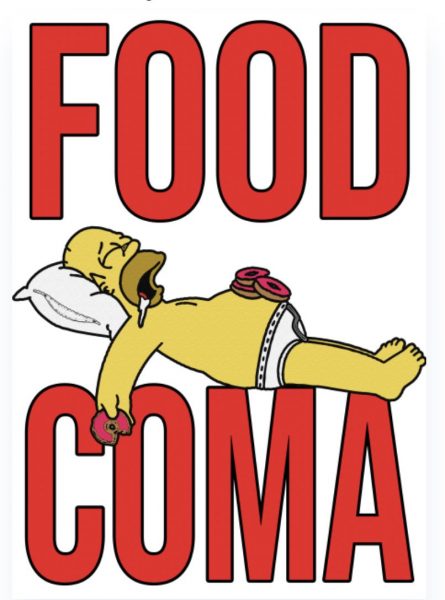
If instead you eat a massive meal all at once, too much blood gets shunted to your gut & away from your brain.

Food coma!
3) For satiety: the initial pause after breaking your fast helps modulate your “hunger hormones.”

Ghrelin is a hormone also released by your stomach when you’re hungry.

It’s highest right before breaking your fast and goes down when you eat.

Once Ghrelin is down it signals to your brain that you’re full.

This usually takes 45-60 minutes so the added delay after breaking your fast makes it less likely to overeat beyond your stomach’s capacity – a phenomenon way too common in Ramadan.

So if you’re fasting, following this process of taking a brief pause, AND paying attention to food quality then you shouldn’t gain weight during Ramadan.

If you find yourself GAINING despite 14 hours of fasting and with everything else being equal then something’s wrong.

In that case, you must explore what you’re eating and the way you’re eating.

So what did the Prophet PBUH do?

He used this time to pray Maghreb, the sunset prayer.

This prayer can be brief.

No need to extend it.

The time for longer prayers is after Isha (Taraweeh/Qiyam prayers).

And now you’re ready for the rest of your meal!

I urge you to again pay attention to quantity and quality here.

In terms of quantity, the Prophet PBUH reminds us to not be gluttonous 👇🏼
As for quality, a common mistake is having high fat meals at the expense of vegetables.

You do need some fat, but too much will cause spikes in triglycerides, increase cholesterol, and make you miss out on other vital macro and micronutrients.

You need enough protein for cellular functions and to ensure you don’t break down muscle during your fast (catabolism).

You need carbs for energy and virtually every physiologic process in your body.

You need vitamins & minerals which largely come from fruits & vegetables

There are a million opinions and diets out there and no single correct path, but whatever you choose just make sure to have balance and moderation.

I like the concept of thirds: Split 1/3 of plate for vegetables (cooked or salad), 1/3 for protein (meat or beans), 1/3 for carbs.

If you ensure at least a third in vegetables it becomes harder to miss out on important nutrients and you end up having less space for fatty/processed foods.

Finally, an often neglected but vital part of the discussion is suhoor (dawn meal).

This should NOT be skipped.
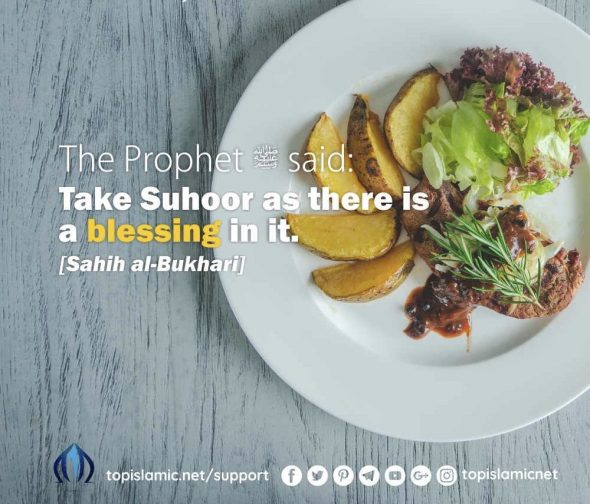
In terms of timing, suhoor should be delayed for two reasons.

1) The closer it is to dawn, the shorter your fast will be.

2) This extends the time from your last large nighttime meal which gives you time to digest and regulate hunger cycles.

For suhoor, focus on foods that give you satiety so you feel full for longer, without spiking your sugar, and without causing you to feel thirsty.

A great choice is Greek yogurt.

Hummus or beans (eg Fava) are also good but you need to mind the salt so you don’t feel thirsty.

And of course be sure to hydrate adequately, especially if you’ll be outdoors or perspiring during the day.

I hope you found this helpful!

I wish you all a healthy month ahead full of forgivenesses, gratitude, and blessings.

I pray for relief and peace to all those struggling through difficult times around the world.

#RamadanKareem to all.”

— By Haitham Ahmed, MD, MPH, Chair of Cardiology at AdvantageCare Physicians, New York, NY
AsalamAlay Everybody,

On this Friday Evening, April 1 2022,

There is overcast sky covering the entire Toronto Metropolitan Area.

Nevertheless, after praying Maghrib I still went out and looked for the New Crescent.

I could not see it because of complete cloud cover.

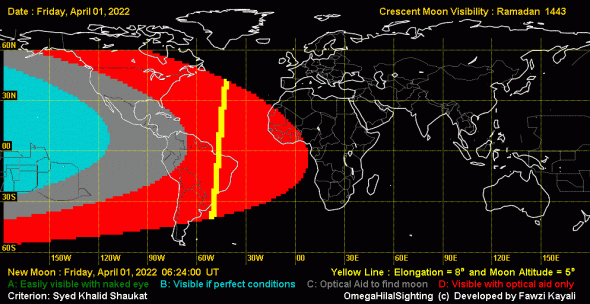
This is a Negative Moonsighting Report from Brampton, Ontario, Canada on Friday April 1 2022.

Ramadan ( Almost ) Mubarak to All !

Salam,

HïMY SYeD

Elsewhere . . .

Moonsighting.com :

“Seen:

Mr Syed Shahid Rashid from San Diego, CA reported:

On April 1, 2022, Hilal was seen with optical aid only.

I am in direct contact with brothers who have been able to sight with optical aid only.

Dr. Farooq Rahman and Mufti Shakeeb with 15+ people spotted the moon with aid from Mount Laguna that is 4000 feet above ground.

Nobody was able to see without aid as Dr. Rahman reported to me.”

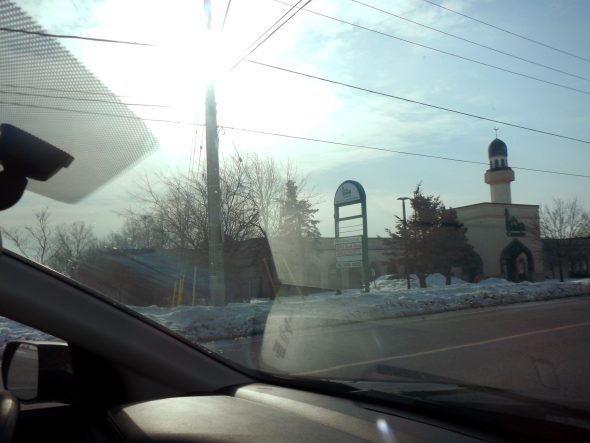
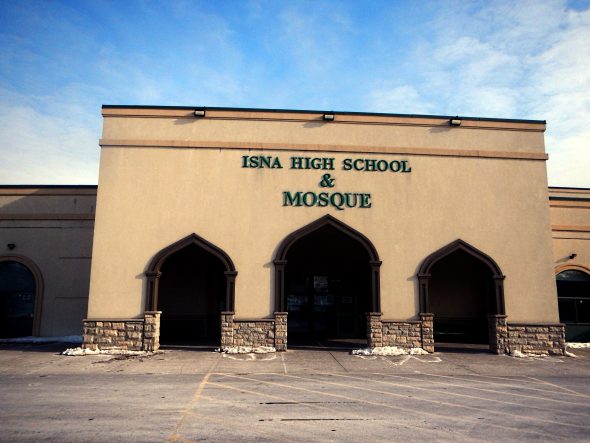
When my brother Amir spotted this Mobile Vaccination Clinic to be held at ISNA’s Islamic Centre of Canada, he signed us up both for today, Sunday Jaunary 30 2022.


I previously wrote about getting my first COVID-19 mRNA shot at ICCO, Islamic Community Centre of Ontario, over on my City of Labyrinths blog :

First Dose – Mobile Vaccination Clinic – MAC ICCO – Muslim Association of Canada – Islamic Community Centre of Ontario – 2550 Dunwin Drive, Mississauga

My brother and I were already double-dosed fully vaccinated last year.

This Sunday Morning we’d be getting our third shot Boosters.

We were able to book appointments for 11:00 a.m. and 11:30 a.m.

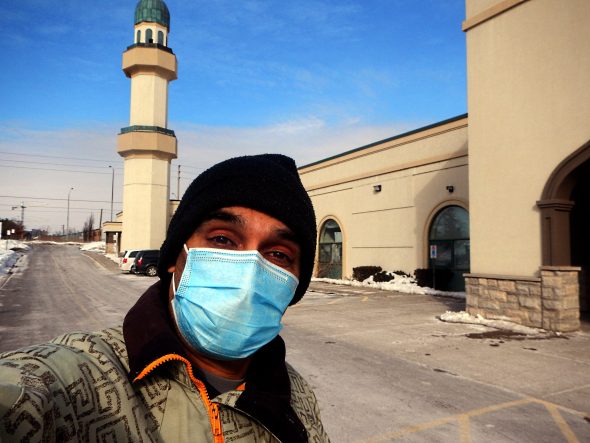
Arriving at a quarter to eleven this morning, we found a nearly empty front parking lot at ISNA.

Parking opposite the primary entrance to ISNA High School is unusual for us.

Mostly when visiting the Islamic Centre of Canada, we have to hunt for a parking spot in the much larger south parking lot.

I was early, as were about a dozen other Muslims.

Being the first cohort, for lack of a better term, of the day, meant today’s Mobile Vaccination Clinic wasn’t immediately ready at 11:00 a.m. on the dot.

No one in line seemed to mind as we all stood six feet apart from each other for an additional 20 minutes.

Almost didn’t feel the time pass at all, despite looking at my watch every so often.

It afforded me the ability to privately recite short Islamic prayers, Dhikr, while inside of a Masjid Proper. Something of a rare privilege during the numerous lockdowns since early 2020.

So lesson learned is, whenever you have the chance to make Dhikr inside a masjid, be quick and get to it!

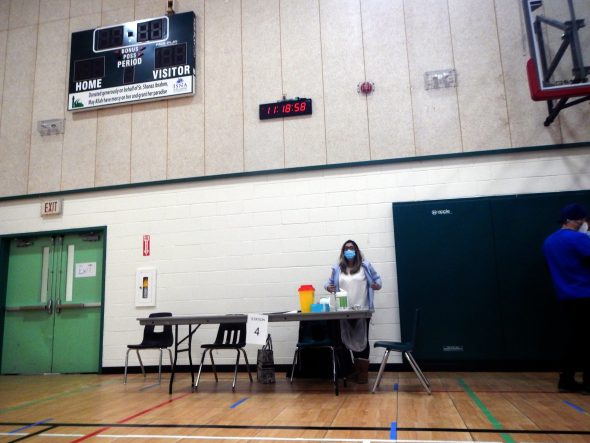
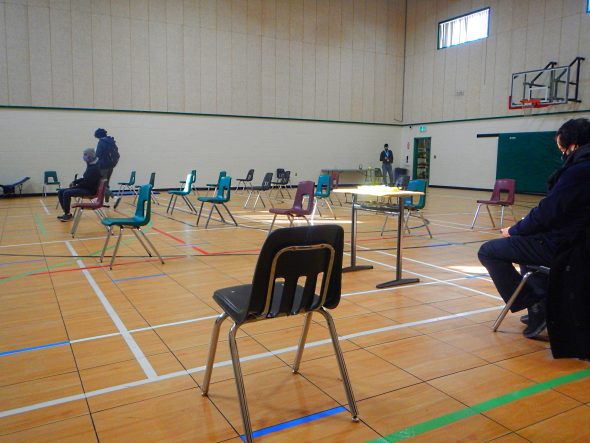
The Vaccination Clinic was set up inside the ISNA High School Gym.

The Gym was divided into two sections by unfolding the giant dividing sliding wall panels.

A section each for men and women.

The separate women’s section allowed privacy for Muslim Women when getting their Shots in the upper arms.

The men’s section had a total of four people waiting for shots.

I didn’t have to wait long at all.

Unlike the feeling I physically experienced when I got my first COVID-19 jab in the arm last year, this time I almost felt nothing.

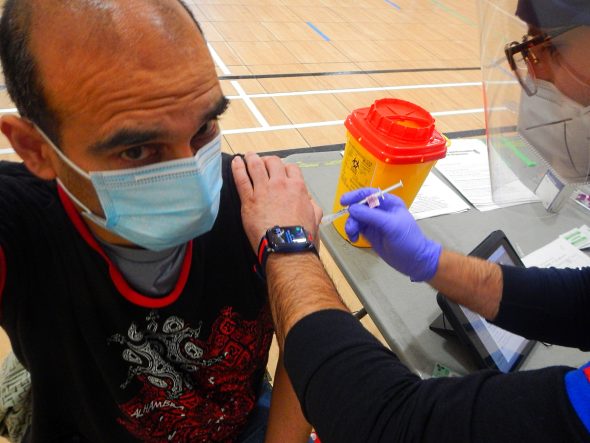
The Doctor administering my shot asked me IF I got the photograph I wanted as he jabbed me ?

I couldn’t even tell that the needle was in my arm.

Afterwards I would wonder if a different needle technology was used so it was painless ?

I asked the Doctor how long I should keep the band-aid covering the spot where I was jabbed.

The band-aid was mostly unnecessary he informed me. It was applied as precaution to alleviate any rare instance of a drop or two of blood appearing around the jab location.

Well, no reason to keep mine on then, and the Doctor removed my band-aid.

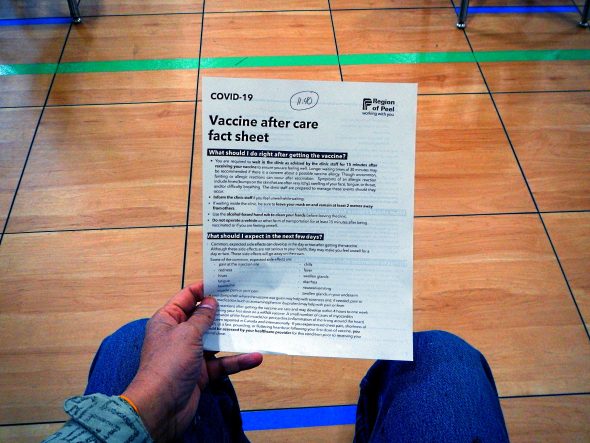
After getting each of the first vaccine two doses, we had to stick around for 15 minutes.

For boosters, we only had to wait for five minutes.

If driving, they asked people to still wait for the full 15 minutes.

By now my brother had also had his booster jab all done.

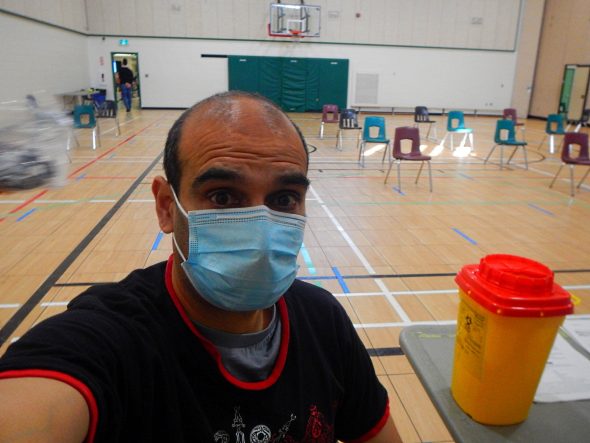
We waited in a mostly empty half-gymnasium.

Masjids can easily be described as Empty Rooms with Carpets.

This Sunday morning’s Mobile Vaccination Clinic inside ISNA was an Empty Gym with Chairs.

There was something so Boringly Routine about today.

Everybody was going through the motions…

The Volunteers, The Medical Staff, ISNA’s Vaccination Volunteers, and we, the Waiting-to-be Third time Jabbed.

Ramadan comes around once every Lunar year.

We don’t yet know if Muslims visiting Mobile Vaccination & Booster Clinics at Masjids is now also annually necessary.

Allah-hu-Alam.

And Allah, Glorified and Praised be He, knows best.