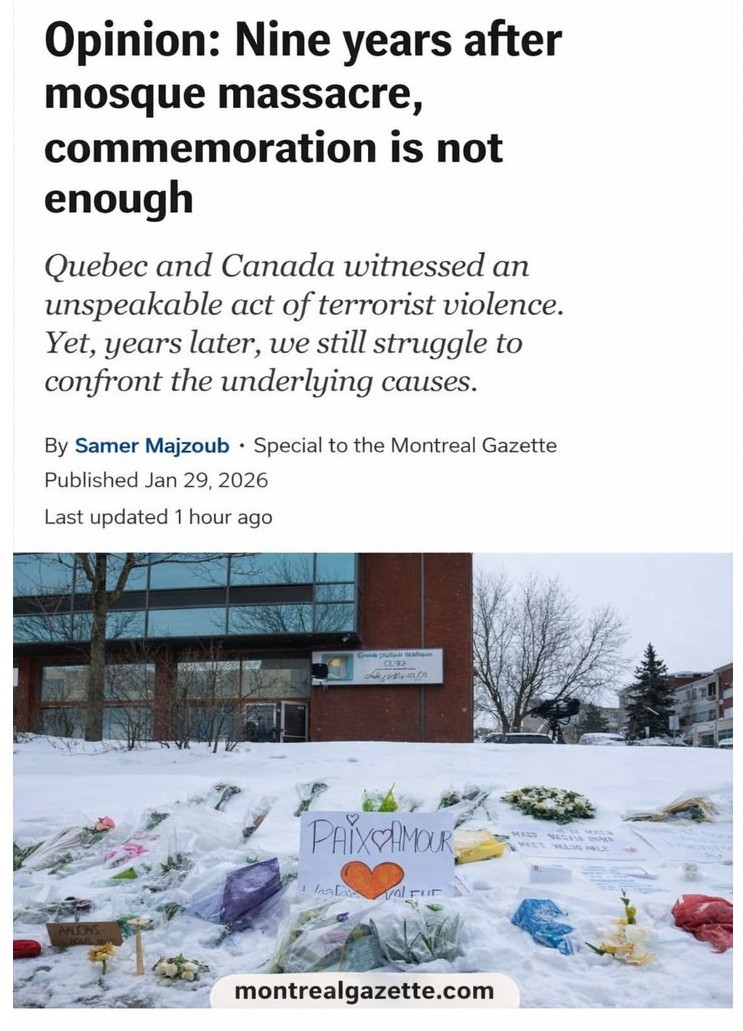
Flowers and messages are placed outside the Quebec City mosque in the days after the mass shooting on Jan. 29, 2017. Nine years later, what have we learned, asks Samer Majzoub of the Canadian Muslim Forum. ( PHOTO BY ALICE CHICHE )
On the evening of Jan. 29, 2017, my phone rang.
Friends in Quebec City were calling, their voices trembling with fear.
They said they could hear gunfire coming from inside the Islamic Cultural Centre.
At first, it was impossible to understand.
Then, in an unbearable instant, the truth became clear: six men had been shot dead while they were praying.
Fathers, sons, brothers, husbands — gone in the coldest of violent hateful acts.
They were Quebecers.
They were killed during one of the most peaceful moments of human life.
Their only “fault” was being citizens of Muslim faith.
In an instant, 17 children were left without a parent.
The shock extended far beyond the Muslim community.
Quebecers and Canadians of diverse backgrounds struggled to comprehend how such an act could occur here.
That night, we were drawn into non-stop media interviews, local and international.
The same question kept returning: How could this happen in Canada?
The answer was neither mysterious nor sudden.
It lay in a climate where hate had been allowed to grow.
Islamophobia had been minimized or dismissed.
Inflammatory rhetoric, including from public figures, had steadily entered mainstream discourse.
Words, repeated often enough, shape attitudes. Attitudes, left unchallenged, can lead to violence.
Quebec and Canada had witnessed an unspeakable act of terrorist violence.
Yet, years later, we still struggle to confront the underlying causes with the seriousness it requires.
As we mark another anniversary on Jan. 29, the central question remains: What have we learned?
Nine years later, the evidence suggests: not enough.
Citizens of Muslim faith and other communities across the country continue to report hate incidents and violence, harassment, threats and vandalism.
Religious and community institutions remain concerned about security.
Public debates around identity and “secularism” too often drift into language that portrays communities as suspect or incompatible.
While disagreement is central to democracy, persistent stigmatization carries consequences.
This is not about suppressing debate or limiting free expression.
It is about responsibility.
Political leaders, commentators and institutions must recognize that language matters.
When communities are framed as problems to be managed, trust erodes.
When fear becomes a political tool, social cohesion weakens.
Jan. 29 should not be viewed solely as the act of a single individual.
It represented the most extreme outcome of an environment in which Muslim Quebecers and Canadians were frequently discussed as threats rather than as fellow citizens.
Violence does not emerge in a vacuum; it takes root where dehumanization is tolerated.
Commemoration alone is insufficient.
Remembrance must be paired with action.
That action begins with education.
Schools play a critical role in fostering media literacy, critical thinking and respect for difference.
Young people must be equipped to recognize and challenge stereotypes before they harden.
It also requires political leadership.
Elected officials must resist the temptation to exploit fear or division for short-term gain.
Clear and consistent opposition to racism and religious hatred is essential.
Media institutions, too, carry responsibility.
Coverage that is accurate, contextual and humanizing strengthens public understanding and social trust.
Above all, the six men who were killed must be remembered as individuals, not symbols.
They were members of our society whose lives were taken in an act of hatred that continues to affect families and communities.
We in Quebec and across Canada often affirm our commitment to equality, dignity and social peace.
Those values are tested not in words, but in practice.
Jan. 29, 2017, was such a test.
The real measure of our response lies in whether we reduce the conditions that allow hatred to escalate into violence.
Honouring the victims means ensuring that no one is targeted because of their faith or identity.
It means rejecting rhetoric that divides and choosing discourse that strengthens social cohesion.
“Never again” must be more than a phrase. It must be a sustained commitment.
Mosques, synagogues, churches and community centres have been vandalized, threatened, and attacked.
No democracy can tolerate intimidation that seeks to silence people or prevent them from worshipping, gathering or belonging.
Samer Majzoub is co-founder and president of the Canadian Muslim Forum, a Montreal-based national organization dedicated to promoting inclusion, dialogue, civic engagement and active citizenship.
